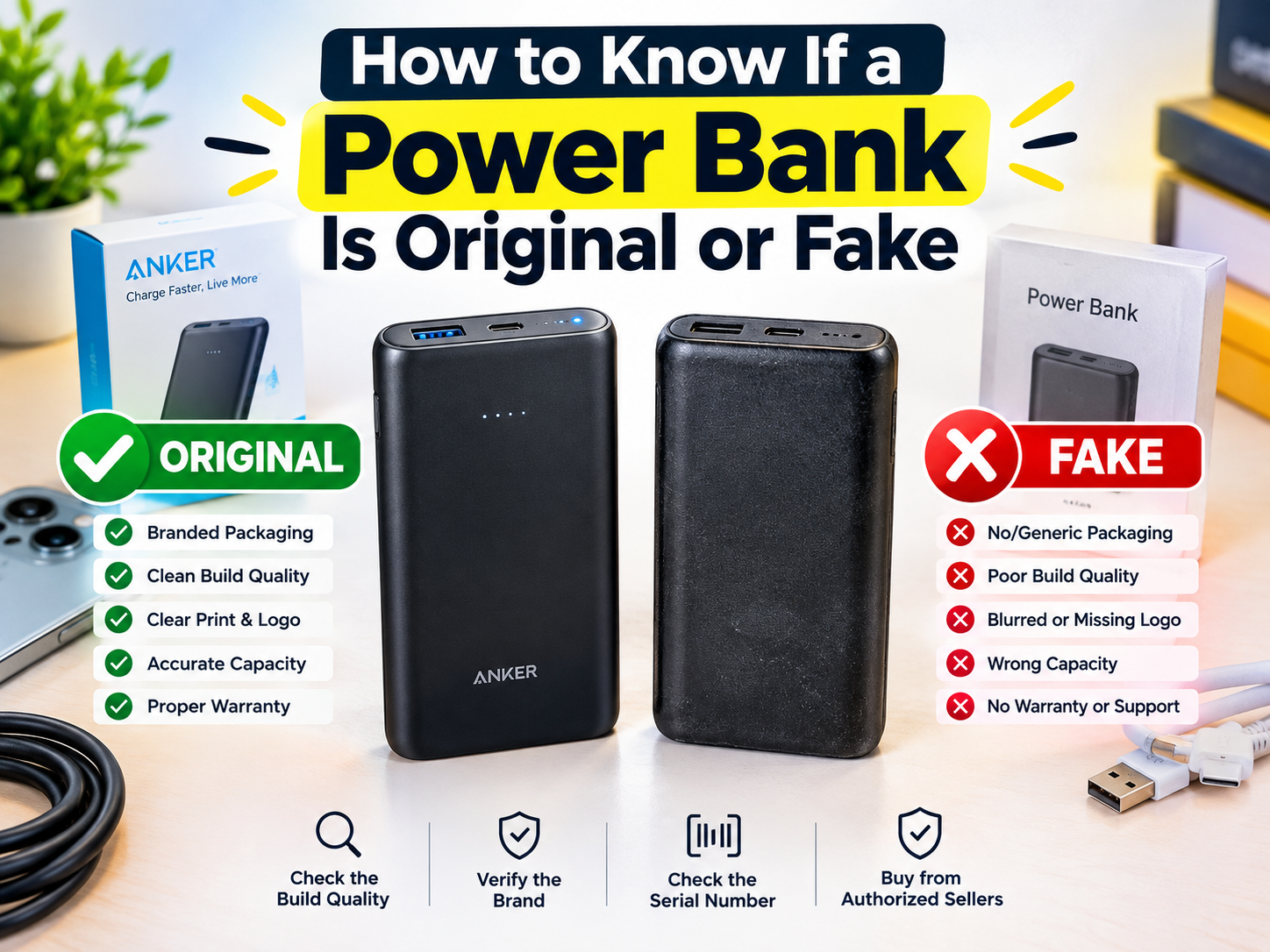
Power banks are useful accessories for charging smartphones, wireless earbuds, and other portable devices when a wall socket is not available. However, choosing the right power bank can be difficult when many products look similar but differ in quality, battery capacity, charging performance, and safety.
If you are wondering how to know if a power bank is original or fake, there are several things you can check before buying. Packaging, product labels, seller reputation, advertised capacity, charging performance, and safety features can help you make a more informed decision.
This guide explains how to identify a genuine power bank, recognise warning signs of a potentially counterfeit product, and choose a reliable option when shopping online or in physical stores in Pakistan.
Why Is It Important to Buy an Original Power Bank?
A power bank contains a rechargeable battery and electronic charging circuits. Product quality matters because these components affect charging reliability, battery performance, and safe operation.
A counterfeit or poorly manufactured power bank may have misleading specifications, unreliable charging, lower capacity than advertised, or inadequate protection against electrical faults. Not every inexpensive or unbranded power bank is fake, but buyers should verify product claims instead of relying on appearance or price alone.
Choosing a reliable product can help you avoid unexpected performance problems and reduce the risks associated with poorly manufactured batteries.
1. Check the Packaging Carefully
Packaging is one of the first things you can inspect when purchasing a power bank. Genuine products from established brands generally have packaging that follows the manufacturer’s usual design and labelling standards.
Look for the following details:
- Clear printing: Product names, specifications, and instructions should be readable.
- Correct branding: Compare the logo and product design with information published by the manufacturer.
- Specification labels: Look for the stated battery capacity, input ratings, output ratings, and model information where applicable.
- Manufacturer information: Check whether the package identifies the manufacturer or responsible company.
- Safety instructions: Reliable products should provide appropriate usage and safety information.
Misspelled words, inconsistent logos, poor-quality printing, or contradictory specifications can be warning signs. However, packaging alone cannot prove that a product is genuine, because counterfeit sellers can copy original designs.
2. Verify the Brand and Model Number
Before buying a branded power bank, find its exact model number and compare it with the manufacturer’s official product information.
Check whether the advertised capacity, design, ports, colour options, and charging specifications match the information for that model. Be cautious if a seller uses a genuine brand name but provides specifications that cannot be verified.
If the manufacturer provides a product verification service or an official list of authorised sellers, use that resource. Do not assume that a product is genuine simply because the logo looks correct.
What if the brand has no official website?
If the manufacturer has limited online information, look for consistent product documentation, a clear seller identity, a reasonable return policy, and verifiable contact details. These checks do not guarantee authenticity, but they can help you assess the seller’s credibility.
3. Check the Serial Number or Verification Code
Some manufacturers include a serial number, QR code, scratch-off verification label, or other product authentication feature. If your power bank has one, check whether the manufacturer explains how to use it.
Follow these steps:
- Locate the serial number or verification label on the product or packaging.
- Visit the manufacturer’s official website by entering its address yourself or using a trusted source.
- Follow the manufacturer’s stated verification procedure.
- Check whether the returned model and product details match your purchase.
- Contact the manufacturer if the code is invalid or the result is unclear.
Be careful with QR codes that open unfamiliar websites. A QR code is not proof of authenticity on its own, and counterfeit products may carry copied codes. A successful result is most useful when it comes from a trustworthy, manufacturer-operated verification system.
4. Compare the Advertised Capacity With the Product Specifications
Battery capacity is usually advertised in milliampere-hours (mAh). Common power bank capacities include 5,000mAh, 10,000mAh, and 20,000mAh.
When checking a power bank, compare the advertised capacity with the label and the manufacturer’s official specifications. If the same model is described as 10,000mAh in one place and 30,000mAh in another without a clear explanation, ask the seller for clarification.
It is also important to understand that a power bank’s rated battery capacity is not the same as the amount of charge it can deliver to a phone. Energy conversion losses mean that the usable output is lower than the battery’s nominal capacity.
For example, a 10,000mAh power bank will not necessarily charge every 5,000mAh smartphone battery exactly twice. The actual number of charges depends on voltage conversion, efficiency, device usage, and charging conditions.
Can you verify capacity using a USB tester?
A suitable USB power meter or battery testing device can help measure the energy delivered through the output during a controlled test. However, the result depends on the testing method, voltage, load, temperature, and conversion losses.
A simple phone charging test is not enough to establish the exact internal battery capacity. If the specifications appear suspicious, seek a proper test or choose a seller who can provide credible product documentation.
5. Be Careful With Extremely Low Prices
Price is another factor to consider when buying a power bank. A product advertised at a price far below comparable models may be worth investigating, particularly if the listing promises an unusually high capacity and very fast charging.
However, a low price does not automatically mean a power bank is fake. Discounts, clearance sales, and differences between brands can affect pricing.
Before placing an order, compare the product with similar models and check:
- Whether the seller provides clear product specifications.
- Whether the model can be verified through the manufacturer.
- Whether the product includes a warranty or return policy.
- Whether the product images and description match the item being sold.
- Whether the seller has a credible history of fulfilling orders.
Instead of choosing only the cheapest option, consider the product’s specifications, quality, safety information, and seller reliability.
6. Inspect the Build Quality
When you receive a power bank, examine its exterior before charging or using it. The casing, connectors, buttons, and indicator lights should be consistent with the product’s documented design.
Look for possible warning signs such as:
- Loose or poorly fitted casing components.
- Ports that appear crooked or badly installed.
- Labels that are inconsistent with the product listing.
- Connectors that feel unusually loose or unstable.
- Cracks, dents, or other signs of damage.
Remember that build quality alone does not establish authenticity. Some counterfeit products look convincing, while legitimate budget models may use simpler materials. Compare the product with reliable manufacturer images and documentation rather than judging only by appearance.
7. Test the Charging Performance Safely
A power bank should provide charging performance consistent with its specifications and the requirements of your device. A product that repeatedly disconnects, fails to charge compatible devices, or behaves unpredictably may have a defect or compatibility problem.
To check basic operation:
- Read the manufacturer’s instructions before using the power bank for the first time.
- Charge it using a compatible, reputable charger and cable.
- Connect a compatible phone or accessory.
- Check whether charging starts and remains stable.
- Compare the charging behaviour with the advertised output and your device’s requirements.
Do not expect every phone to charge at the same speed. Actual performance depends on the phone, cable, charging protocol, temperature, and current battery level.
A normal charging test also cannot prove that a power bank is original. If you suspect counterfeit electronics or unsafe construction, do not attempt invasive testing or open the casing.
8. Check the USB Ports and Fast-Charging Support
Power banks can include USB-A, USB-C, or built-in charging cables. Some models support fast-charging technologies, while others provide standard charging speeds.
Check the official specifications for the exact model rather than relying on large numbers printed on the packaging. Confirm the following:
- Which ports support input and which support output.
- The output voltage and current ratings.
- The maximum supported charging power.
- Whether the required fast-charging protocol is supported.
- Whether multiple connected devices share the available power.
A power bank advertising 22.5W output will not necessarily charge every smartphone at 22.5W. The phone and power bank must support compatible charging standards for the expected performance.
9. Look for Reliable Safety Information
Because power banks contain rechargeable batteries, safety information is an important part of the purchasing decision. Look for clear instructions, electrical ratings, manufacturer details, and relevant conformity information where applicable.
Depending on the market and product, recognised safety or conformity markings may be relevant. However, a printed symbol by itself does not prove that a product has been independently tested. If authenticity or compliance matters, verify the documentation with the manufacturer or the relevant certification body.
Avoid using a power bank that is swollen, leaking, cracked, unusually hot, or emitting a strange smell. Stop using it if you notice these signs and arrange safe handling through a qualified service provider.
10. Buy From a Trusted Seller
Buying from a credible seller is one of the simplest ways to reduce the risk of receiving a counterfeit or misrepresented product.
Before purchasing online in Pakistan, check whether the seller provides:
- A clear product description with consistent specifications.
- Realistic product photographs and identifiable model information.
- Transparent pricing and delivery information.
- A clear return, replacement, or warranty policy.
- Contact details for customer support.
Read customer reviews carefully, but do not rely on ratings alone. Reviews can be incomplete or unreliable, so compare them with product documentation and the seller’s policies.
You can also browse the available accessories at Techify.pk. Before ordering any product, read its current listing and check the stated features, compatibility, and applicable return or warranty terms.
Power Bank Buying Checklist
Use this quick checklist before you purchase a power bank:
- Confirm the exact brand and model.
- Compare the capacity and output ratings with official specifications.
- Verify the serial number or authentication code if the manufacturer offers this feature.
- Check the quality and consistency of the packaging and product labels.
- Make sure the ports and charging standards suit your devices.
- Review the seller’s reputation and return policy.
- Check for visible damage before use.
- Avoid products with suspicious claims or missing safety information.
Frequently Asked Questions
How can I identify an original power bank?
Check the exact model against the manufacturer’s official specifications, inspect the packaging and labels, use an official verification service if available, and purchase from a credible seller. No single visual check guarantees authenticity.
Can a fake power bank look original?
Yes. Counterfeit products may copy logos, packaging, serial numbers, and product designs. This is why checking manufacturer documentation and using official verification methods is more reliable than judging appearance alone.
Does a heavy power bank mean it is original?
No. Weight varies with battery capacity, internal components, and design. A heavy product is not necessarily genuine, and a lightweight product is not automatically fake.
Can I check whether a power bank is original by its serial number?
Sometimes. This works only when the manufacturer offers a reliable serial-number verification system. A copied or duplicated serial number may still appear on a counterfeit product.
Is a cheap power bank always fake?
No. Budget products and discounted genuine products exist. Check the specifications, seller credibility, warranty terms, and product verification information before making a decision.
Why does my power bank charge my phone slowly?
Possible causes include an incompatible adapter or cable, a phone that does not support the advertised charging protocol, high temperature, or limited output from the power bank. Slow charging alone does not prove that the product is fake.
What should I do if I suspect my power bank is fake?
Stop using it if it shows signs of damage, overheating, swelling, or unusual behaviour. Keep your purchase information and packaging, contact the seller or manufacturer, and request verification or a return according to the applicable policy. Do not open the power bank to inspect its battery.
Final Thoughts
Learning how to know if a power bank is original or fake can help you make a more informed buying decision. Start by checking the brand and model, comparing the advertised specifications, inspecting the packaging, and verifying product details through official channels where possible.
Be cautious of unrealistic capacity claims, inconsistent product information, and sellers who cannot explain their warranty or return policy. Remember that packaging, price, weight, and charging speed are useful clues, but none of them proves authenticity on its own.
For a better shopping experience, compare specifications carefully and choose a seller that provides clear product information. Visit Techify.pk to explore available technology accessories and review the details of each product before purchasing.